Parents of young children tend to frequently encounter physical and cognitive barriers while grocery shopping that can often induce stress and promote inefficiency across the routine. The following research aims to investigate the grocery shopping experience for parents with children under eight who shop with strollers, baby carriers, or children on foot. The rationale for this user study is to achieve a better understanding of how grocery store ecosystems work to accommodate this user group during high-volume and low-volume shopping visits.
Using in-depth interviews, observational studies, and literature review, our study will identify the key pain points in the grocery store shopper experience. Factors such as store layout, user navigation, user accessibility, decision-making, and overall comfort will all be considered. Participants will be chosen based on their shopping frequency and family configuration to ensure the authenticity of their experience and behavior. The data collection will transpire over the course of the academic semester.
This project should result in a clear and defined set of unmet user needs and areas of opportunity to improve the grocery shopping experience for young families. These findings will help inform any future design recommendations focused on making grocery shopping a more supportive, welcoming, and user-friendly experience for young parents in large supermarkets. The research here should ultimately provide insights that can build a culture of repeat
STUDY DESIGN
Rationale and Background Information
This project will focus on how parents with children under eight navigate the grocery shopping experience and how they manage its various physical, emotional, and cognitive demands. For this demographic, grocery shopping is a regular necessity often completed under stress. Shoppers in this environment face potential challenges, including overcrowding and safety concerns. But for parents with young children, these challenges are easily heightened. By studying the complexity of grocery stores as everyday environments, the following project aims to understand and identify the factors contributing to the overall experience for young parents with children.
STUDY DESIGN
Goal, Objectives, and Assumptions
Our goal is to identify and define the various facets of the grocery store experience for young parents shopping with children, with the objective of supporting future user-centered improvements in large supermarkets
Understand the method and frequency of grocery shopping among young parents
Identify the impact of grocery shopping on the lives of young parents.
Understand the shopping experience when young parents shop with their children
Identify what young parents like or dislike during their shopping experience
Identify the perceived easiest and hardest times to shop with children
Understand how to promote a sense of attachment to their grocery store for young parents, leading to repeat visits
1. Our users shop with children
Our users shop in large-scale grocery stores
Potential participants would sign an informed consent form after receiving recruitment material that contains detailed information and discussing the research with the investigator, including that it is voluntary participation. Informed consent would be stored in the team’s SharePoint folder.
Interviews would be conducted virtually or in-person and would be video- and/or audio-recorded for transcription purposes. Recording of the interviews would be stored in the team’s SharePoint for the entire duration of the Spring 2025/2026 semester and for 30 days afterward, at which time the audio recording would be deleted. Participants would be assigned a unique ID, which would be reflected in the transcription and any documentation of research subjects. The interview transcript would be submitted on the learning platform, Canva, to the class instructor for review and grading purposes.
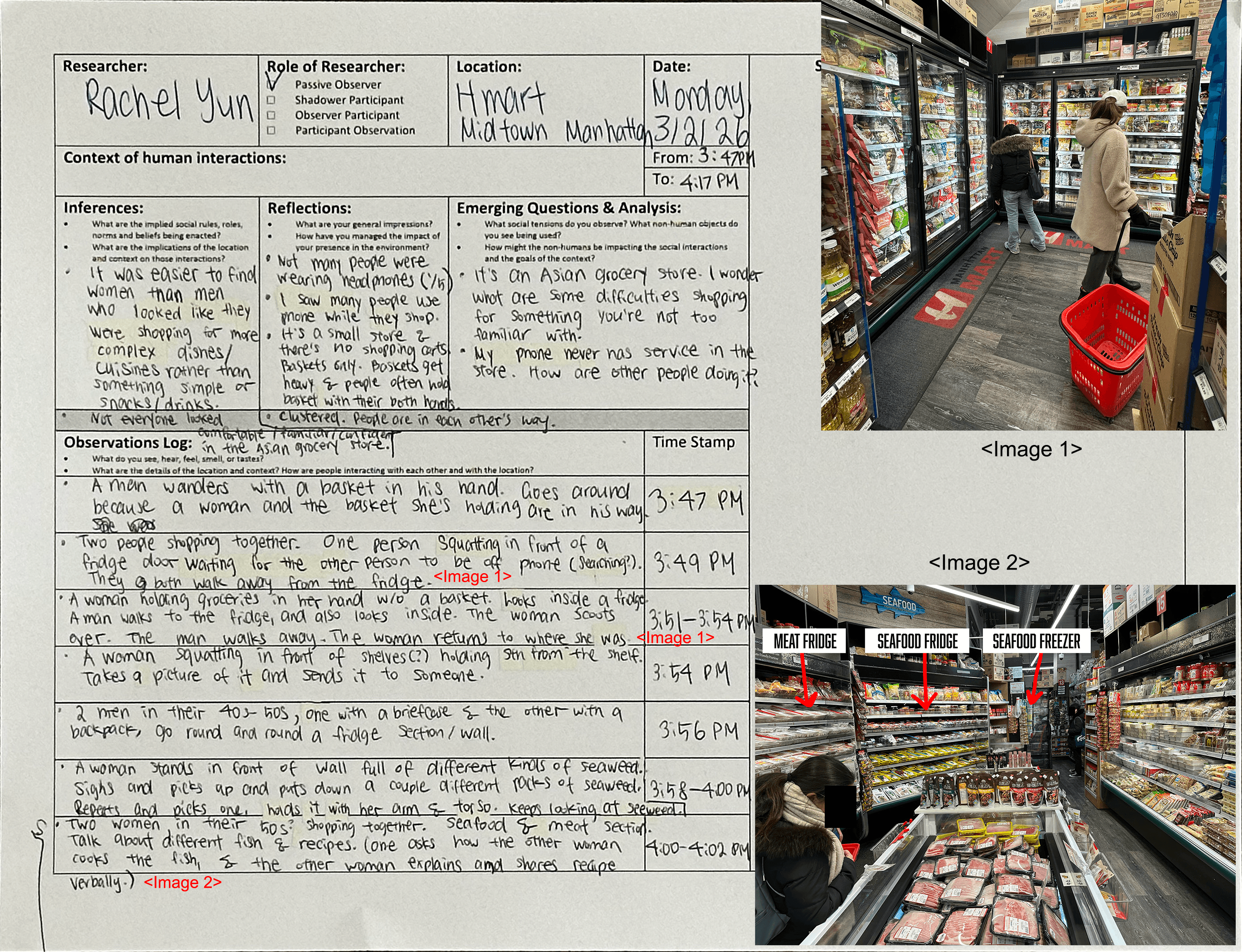
During ethnographic research (observation), detailed notes would be taken by each investigator; however, no photographs, names or other identifying information would be noted.
DISCOVER
PRIMARY RESEARCH - INTERVIEWS
DISCOVER
PRIMARY RESEARCH - INTERVIEWS
Recruitment Advertisement
DISCOVER
PRIMARY RESEARCH - INTERVIEWS
DISCOVER
PRIMARY RESEARCH - INTERVIEWS
Participant Recruitment Strategy
Young parents age 21 - 55 who have a child 8 years or younger and reside in the Northeastern region of the United States.
Young parents age 21 - 55 who have a child 8 years or younger and reside in the Northeastern region of the United States.
Young parents age 21 - 55 who have a child 8 years or younger and reside in the Northeastern region of the United States.
Where to find the participants?
We would recruit using the convenience sampling method. Potential participants would be recruited from investigators social network. In addition, investigators would ask from their social network for referral to other individuals who meet the eligibility criteria. We have chosen this approach for finding participants as with the limited time in this semester, this is the approach most convenient and readily available, especially considering compensation would not be provided for participation.
We would recruit participants by sending messages to our social network, including details through the developed advertisement. Individuals who indicate interest in participating, we would share the screener. Individuals who meet eligibility criteria after completion of the screener would receive more information through the informed consent.
Participants would not receive any monetary compensation as this is research being conducted as part of coursework.
However, participants would receive a summary of findings from the research which could guide their shopping decisions or give them insights into the shopping habits of similar individuals, all of which could provide benefits to the participants.
When Participant Recruitment would start and end
Participant recruitment would begin February 13, 2026, or following the approval of our consent form, advertisement, and screener. Participant recruitment would be expected to continue through February 28, 2026, at which point we expect every investigator would have identified their interview participant(s).
What would make someone eligible (Inclusion Criteria)
Participant is within the age range of 21 – 55
Participant has a child age 8 years old or younger
Participant resides in the Northeastern region of the United States
Participant shops at large national supermarkets (e.g., Target, Walmart, Trader Joe’s, Wegmans etc.)
What would make someone ineligible (Exclusion Criteria)
Participant is 56 years or older
Participant does not have any children 8 years old or younger
Participant shop in small chain
DISCOVER
PRIMARY RESEARCH - INTERVIEWS
Prompt 1. Can you tell me a little about yourself, your family, and your grocery shopping habits?
Probe 1. How many times do you grocery shop a week? Probe 2. What grocery stores do you usually go to?
Probe 2. What grocery stores do you usually go to?
Prompt 1. Please share your experience of navigating grocery shopping in the store.
Probe 1. How would you describe the ease of navigating this store(s)?
Probe 2. What makes navigating a grocery store easy?
Clarifier 1. Could you please tell me more about (placement of items, width of aisles, etc)
Prompt 3. Walk me through your typical grocery shopping trip, from start to end.
Probe 1. How do you prepare?
Probe 2. What are some factors you consider while deciding to shop for groceries?
Clarifier 1. Could you please elaborate on/tell me more about ...
Prompt 4. Please share your experience of shopping with children.
Probe 1. What do you like about shopping with children?
Probe 2. How do you feel about shopping with children?
Probe 3. Do you think your children’s age affects your shopping experience?
Clarifier 1. Could you please elaborate on/tell me more about ...
Prompt 5. Do you think your children like going grocery shopping with you? Why?
Probe 1. What do they seem to enjoy?
Probe 2. Have you done anything you do to make their experience better?
Clarifier 1. Could you please elaborate on/tell me more about ...
Prompt 6. If you could design your perfect grocery experience, what would that look like?
Probe 1. What services or options would you include in the experience?
Probe 2. Is there anything you would change about your current experience?
Clarifier 1. Could you please elaborate on/tell me more about ...
Closing question: Is there anything about your grocery experience that we have not discussed today that you think would be important to consider?
DISCOVER
PRIMARY RESEARCH - OBSERVATION
DISCOVER
PRIMARY RESEARCH - PROBE KIT
Probe Kit Prototype & Rationale
DEFINE
PRIMARY RESEARCH - INTERVIEWS
DEFINE
SECONDARY RESEARCH
Secondary Research Report
DEFINE
PRIMARY RESEARCH - INTERVIEWS
Data Analysis & Coded Data Set
1. Can you tell me a little about yourself, your family, and your grocery shopping habits?
2. Please share your experience of navigating grocery shopping in the store.
3. Walk me through your typical grocery shopping trip, from start to end.
4. Please share your experience of shopping with children.
5. If you could design your perfect grocery experience, what would that look like?
Household & Contextual Background
Household & Contextual Background
Shopping Modality & Logistics
Shopping Modality & Logistics
Shopping Process & Preparation
Shopping Process & Preparation
Children's Role & Influence
Children's Role & Influence
Desired Improvements & Ideal Experience
Desired Improvements & Ideal Experience
Household & Contextual Background - 8 times (15.38461538%)
Household & Contextual Background - 8 times (15.38461538%)
Shopping Modality & Logistics - 11 times (21.15384615%)
Shopping Modality & Logistics - 11 times (21.15384615%)
Shopping Process & Preparation - 8 times (15.38461538%)
Shopping Process & Preparation - 8 times (15.38461538%)
In-Store Navigation - 6 times (11.53846154%)
In-Store Navigation - 6 times (11.53846154%)
Children's Role & Influence - 7 times (13.46153846%)
Children's Role & Influence - 7 times (13.46153846%)
Challenges with Children - 3 times (5.769230769%)
Challenges with Children - 3 times (5.769230769%)
Desired Improvements & Ideal Experience - 5 times (9.615384615%)
Desired Improvements & Ideal Experience - 5 times (9.615384615%)
DEFINE
PRIMARY RESEARCH - INTERVIEWS
POVs and HMWs with Solution Design Recommendations
1
1. POV (Point of View)
A city-dwelling parent without a car need to carefully plan grocery trip around transportation options and store proximity because living in an urban area/city without a car turns grocery shopping into its own logistical challenge that requires plenty advanced planning.
A city-dwelling parent without a car need to carefully plan grocery trip around transportation options and store proximity because living in an urban area/city without a car turns grocery shopping into its own logistical challenge that requires plenty advanced planning.
2. HMW (How Might We)
How might reduce the planning burden of grocery shopping for car-free urban parents in order to make it grocery shopping feel more routine and stress-free?
How might reduce the planning burden of grocery shopping for car-free urban parents in order to make it grocery shopping feel more routine and stress-free?
3. Solution Design Recommendations
After paying, either right past the checkout or at the counter, customers can have their groceries delivered. Staff will seal and secure the items in a box in front of the customer before delivering them to their door. This eliminates the uncertainty of online/curbside/pickup orders and the physical strain of transporting heavy bags on public transportation.
After paying, either right past the checkout or at the counter, customers can have their groceries delivered. Staff will seal and secure the items in a box in front of the customer before delivering them to their door. This eliminates the uncertainty of online/curbside/pickup orders and the physical strain of transporting heavy bags on public transportation.
2
1. POV (Point of View)
A city-dwelling parent without a car need to carefully plan grocery trip around transportation options and store proximity because living in an urban area/city without a car turns grocery shopping into its own logistical challenge that requires plenty advanced planning.
A city-dwelling parent without a car need to carefully plan grocery trip around transportation options and store proximity because living in an urban area/city without a car turns grocery shopping into its own logistical challenge that requires plenty advanced planning.
2. HMW (How Might We)
How might we reduce the physical strain of bringing groceries home for parents in order to avoid managing heavy bags on public transportation while paying attention to their children?
How might we reduce the physical strain of bringing groceries home for parents in order to avoid managing heavy bags on public transportation while paying attention to their children?
3. Solution Design Recommendations
Providing children with activities or toys can keep them engaged, allowing parents more uninterrupted time for shopping. For children who like to stay in the cart, built-in features such as playground puzzles can provide entertainment without reducing shopping cart storage capacity. This solution resolves common complaints regarding toy car shopping carts, which often make shopping cart space for groceries significantly smaller due to the bulky design of the toy car.
Providing children with activities or toys can keep them engaged, allowing parents more uninterrupted time for shopping. For children who like to stay in the cart, built-in features such as playground puzzles can provide entertainment without reducing shopping cart storage capacity. This solution resolves common complaints regarding toy car shopping carts, which often make shopping cart space for groceries significantly smaller due to the bulky design of the toy car.
3
1. POV (Point of View)
A parent who shops at multiple stores needs to maintain a running list that matches each trip/item to the right store because different stores serve different purposes/have different ranges.
A parent who shops at multiple stores needs to maintain a running list that matches each trip/item to the right store because different stores serve different purposes/have different ranges.
2. HMW (How Might We)
How might we organize grocery lists for multi-store shoppers in order to eliminate the mental load of deciding what to buy where on every trip?
How might we organize grocery lists for multi-store shoppers in order to eliminate the mental load of deciding what to buy where on every trip?
3. Solution Design Recommendations
To eliminate the mental load of deciding what to buy, a grocery app or system that organizes and assembles lists of what stores have the items that best suit the needs of the shopper. This solution could be a hybrid of budget tracking, public reviews of each grocery location, and recommendations based on past purchases. It could cross-compare store distances and prices, while also providing substitutions that are cheaper or healthier.
To eliminate the mental load of deciding what to buy, a grocery app or system that organizes and assembles lists of what stores have the items that best suit the needs of the shopper. This solution could be a hybrid of budget tracking, public reviews of each grocery location, and recommendations based on past purchases. It could cross-compare store distances and prices, while also providing substitutions that are cheaper or healthier.
4
1. POV (Point of View)
A parent shopping for entire household needs to balance store proximity, affordability, and product freshness because with limited time and money, it can be hard compromising on any of the factors.
A parent shopping for entire household needs to balance store proximity, affordability, and product freshness because with limited time and money, it can be hard compromising on any of the factors.
2. HMW (How Might We)
How might we ensure shoppers are able to assess store and products on the criteria: affordability, freshness, and proximity for budget-conscious parents in order to remove the pressure and feeling that they are sacrificing one need for another?
How might we ensure shoppers are able to assess store and products on the criteria: affordability, freshness, and proximity for budget-conscious parents in order to remove the pressure and feeling that they are sacrificing one need for another?
3. Solution Design Recommendations
To ensure shoppers are able to assess stores and products on their needed criteria's, using a series of graphics and informatics sent to each user through text message or email tailored to their shopping needs in affordability, freshness, and proximity could help combat this problem for shoppers.
To ensure shoppers are able to assess stores and products on their needed criteria's, using a series of graphics and informatics sent to each user through text message or email tailored to their shopping needs in affordability, freshness, and proximity could help combat this problem for shoppers.
5
1. POV (Point of View)
A parent shopping with a child needs to channel their child’s natural curiosity while grocery shopping because when shopping is stimulating for children, it becomes manageable for the parent and enjoyable for the child and reduces friction.
A parent shopping with a child needs to channel their child’s natural curiosity while grocery shopping because when shopping is stimulating for children, it becomes manageable for the parent and enjoyable for the child and reduces friction.
2. HMW (How Might We)
How might we ensure a child’s mood never decides the success of a shopping trip for parents in order to allow them the time to take a look and find every item on their lists?
How might we ensure a child’s mood never decides the success of a shopping trip for parents in order to allow them the time to take a look and find every item on their lists?
3. Solution Design Recommendations
To ensure a child's mood never dictates the success of a grocery shopping outing, designing a grocery shopping system that takes the tasks needed to be completed by the shopper into an interactive, quest-based experience. A system that gamifies the shopping practice would involve the child as an active participant of the shopping experience, rather than a distraction to the parent.
To ensure a child's mood never dictates the success of a grocery shopping outing, designing a grocery shopping system that takes the tasks needed to be completed by the shopper into an interactive, quest-based experience. A system that gamifies the shopping practice would involve the child as an active participant of the shopping experience, rather than a distraction to the parent.
6
1. POV (Point of View)
A parent shopping with a child needs to channel their child’s natural curiosity while grocery shopping because when shopping is stimulating for children, it becomes manageable for the parent and enjoyable for the child and reduces friction.
A parent shopping with a child needs to channel their child’s natural curiosity while grocery shopping because when shopping is stimulating for children, it becomes manageable for the parent and enjoyable for the child and reduces friction.
2. HMW (How Might We)
How might we design engaging in-store experiences for parents with young children in order to transform a child’s energy and natural curiosity from a distraction into something that supports the shopping experience?
How might we design engaging in-store experiences for parents with young children in order to transform a child’s energy and natural curiosity from a distraction into something that supports the shopping experience?
3. Solution Design Recommendations
To design engaging experiences for parents with young children, we could implement things into the environment that empower children. Additions like color-coded navigation systems for aisles and items, choice prompts for children to find specific items on shelves, and positive reinforcement sticks and badges at checkout for child shoppers could help them engage more and feel appreciated.
To design engaging experiences for parents with young children, we could implement things into the environment that empower children. Additions like color-coded navigation systems for aisles and items, choice prompts for children to find specific items on shelves, and positive reinforcement sticks and badges at checkout for child shoppers could help them engage more and feel appreciated.
7
1. POV (Point of View)
A parent in a crowded store with children needs to move through the store efficiently because simultaneously managing child safety and product selection in a crowded store can feel overwhelming.
A parent in a crowded store with children needs to move through the store efficiently because simultaneously managing child safety and product selection in a crowded store can feel overwhelming.
2. HMW (How Might We)
How might we re-design store layout and navigation for parents with young children in order to allow easy navigation without splitting their attention between their cart and child?
How might we re-design store layout and navigation for parents with young children in order to allow easy navigation without splitting their attention between their cart and child?
3. Solution Design Recommendations
Develop a parent mode option within the store grocery app, that allows parents to add their shopping list and received a customized shopping path/route through the store for their items to increase efficiency navigating the store especially during crowded hours.
Develop a parent mode option within the store grocery app, that allows parents to add their shopping list and received a customized shopping path/route through the store for their items to increase efficiency navigating the store especially during crowded hours.
8
1. POV (Point of View)
A parent in a crowded store with children needs to move through the store efficiently because simultaneously managing child safety and product selection in a crowded store can feel overwhelming.
A parent in a crowded store with children needs to move through the store efficiently because simultaneously managing child safety and product selection in a crowded store can feel overwhelming.
2. HMW (How Might We)
How might we keep children secure and safe for parents in order to let parents focus on selecting products?
How might we keep children secure and safe for parents in order to let parents focus on selecting products?
3. Solution Design Recommendations
Offer a timed, grocery store members only childcare zone, staffed by trained childcare professionals, where parents can drop off their child for a limited time period while they grocery shop and pick up their child upon checkout.
Offer a timed, grocery store members only childcare zone, staffed by trained childcare professionals, where parents can drop off their child for a limited time period while they grocery shop and pick up their child upon checkout.
9
1. POV (Point of View)
A parent with young children needs to have access to stores with child-friendly/family-friendly infrastructure because lack of this infrastructure can make shopping more high stress with lots of factors to balance.
A parent with young children needs to have access to stores with child-friendly/family-friendly infrastructure because lack of this infrastructure can make shopping more high stress with lots of factors to balance.
2. HMW (How Might We)
How might we determine the baseline of a family-friendly store while remaining flexible for unique needs for parents in order to satisfy the majority of parents?
How might we determine the baseline of a family-friendly store while remaining flexible for unique needs for parents in order to satisfy the majority of parents?
3. Solution Design Recommendations
Establish a “family-friendly store standard” system with clearly defined set of features (e.g., wider aisles, accessible cart options, stroller-friendly navigation, visible safety measures, and rest areas) that are consistently implemented across stores. This baseline ensures parents know what to expect across locations, while allowing stores to layer in additional features based on neighborhood needs. It also reduces uncertainty and makes shopping feel predictable and supportive rather than stressful.
Establish a “family-friendly store standard” system with clearly defined set of features (e.g., wider aisles, accessible cart options, stroller-friendly navigation, visible safety measures, and rest areas) that are consistently implemented across stores. This baseline ensures parents know what to expect across locations, while allowing stores to layer in additional features based on neighborhood needs. It also reduces uncertainty and makes shopping feel predictable and supportive rather than stressful.
10
1. POV (Point of View)
A parent with young children needs to have access to stores with child-friendly/family-friendly infrastructure because lack of this infrastructure can make shopping more high stress with lots of factors to balance.
A parent with young children needs to have access to stores with child-friendly/family-friendly infrastructure because lack of this infrastructure can make shopping more high stress with lots of factors to balance.
2. HMW (How Might We)
How might we introduce adaptable, child-safe spaces and equipment for families with young children in order to make grocery stores feel designed for them rather than against them?
How might we introduce adaptable, child-safe spaces and equipment for families with young children in order to make grocery stores feel designed for them rather than against them?
3. Solution Design Recommendations
Introduce modular, adaptable cart and mobility systems like carts with attachable child seats, stroller-to-cart connectors, or flexible configurations that accommodate multiple children safely. Pair this with designated child-friendly zones and equipment that parents trust (clean, secure, and customizable) and allow them to shop more confidently without needing to improvise or compromise on safety.
Introduce modular, adaptable cart and mobility systems like carts with attachable child seats, stroller-to-cart connectors, or flexible configurations that accommodate multiple children safely. Pair this with designated child-friendly zones and equipment that parents trust (clean, secure, and customizable) and allow them to shop more confidently without needing to improvise or compromise on safety.
DEVELOP
Recommendations for Design Pitch
Staffseals and secures items after checkout for same-day delivery, eliminating the physical strain of transit for car-free families and the uncertainty of online/curbside/pickup orders.
Gamified Shopping Experience
A quest-based in-store experience that make childrenactive participant of the shopping experience with item-finding tasks, choice prompts, etc.
A store app feature thatallowsparents toadd their shopping list andreceiveda customized shopping path through the store, increasing efficiency of store navigation especially during crowded hours.
A timed, members onlychildcarezone, staffed bytrainedchildcareprofessionals, allowing parents to shop uninterrupted and pick up theirchildupon checkout.
Personalized Price & Freshness Alert
Images and information sent via text or email, informing shoppers of price changes, fresh arrivals, and deals that match users' needs.
OUR SUCCESSIONS
We didn't negotiate physical and cognitive ease with price or freshness of groceries.
We reduced confusion and saved people's time while shopping groceries.
We helped parents shop with less distraction from their children.